Sunday, November 27, 2011

Cross-dressing in Kids Movies

This break I reorganized my DVD cabinet with my mom and I found an old movie called "Ladybugs". This movie is about a man, Chester, who wants a promotion so badly that he takes the coaching position on his boss's daughter's soccer team and promises them a winning season. However, the team is awful and has no chance of winning, until Chester creates a scheme to put his fiance's soccer superstar son, Matthew, on the team disguised as a girl, Martha. The movie shows the transformation scene that we talked about when going over Leutinant Nun. Although, in order to portray a girl Matthew must don a blonde wig and a dress, which he greatly opposes at first, but gives in to after a bit. The movie demonstrates that by encompassing both sexes, a person becomes more complete and thus well-rounded.
This movie also includes a lot of gender stereotypes. There is one scene in particular where one of the girls can not seem to find the aggression to play soccer well, however once her opponent makes her break a nail she becomes enraged and a star soccer player. Thus portraying women as overly emotional and unable to focus unless it is out of an act of vengeance. Also, the audience sees a transformation in Matthew, from a harsh aggressive male to an encouraging and emotionally aware man. The movie also provides the reveal scene, where Matthew takes off his wig in front of the soccer team. However, once he reveals himself to be a boy, the girls revert back to their female gender stereotype; they immediately begin to fix their hair and ask the other girls how they look. Although, by the end of the movie all of the characters have found the confidence to be themselves and stand up to their oppressors.
Here is the link to the clip with the "break a nail" scene:

The Hairy Bird


Looking through old movies I came across a movie called “All I Wanna Do”. This movie is about an all girls boarding school that is looking to make the transition to a coed boarding school. Although you would expect most girls to be excited about this merge, the main characters are extremely distraught. The movie goes through the girls’ conniving pranks and plans to make the boys school appear rowdy and disorderly. Despite the clear tone of female independence in the movie, what first caught my eye were the credits. In the credits there was a funny looking creature, however upon closer examination I realized that it was a penis is the form of bird (wings and all).
This amazed me because I never expected a modern movie to include this phallic symbol. This directly related to the lecture on talking penises. In addition, the main actresses in the movie frequently related quotes back to this phallic bird. This “hairy bird” was a clear sign of oppression to the girls and when they spoke of it, it was generally under a tone of distress. Also, the boys in the movie refer to their genitalia as a bird at several points in the movie. At one point, one of the main actresses shouts out in a fury, “I’m not gonna live in the shadow of the hairy bird,” which demonstrates her anger at men’s dominance over women’s future. However, I found it funny that the girls’ plans to get rid of the boys centered on portraying the young high school boys as oversexed rambunctious individuals. In addition, several of the boys in the movie are completely preoccupied with taking a picture of their dates topless. Overall, I found the spontaneity of the movie intriguing and the characters were witty and charming. In addition, I loved the willingness of the girls to stand up to authority and their refusal to be raised to be trophy wives refreshing. I believe that this movie is one that most people should see because it instills a sense that woman often have better ruling attitudes than people give them credit for.

My Dad is My Mom

Thomas Beatie

Thomas Beatie's pregnancy was not only inspirational but also a phenomenon we rarely see. The willingness to give up one's body to carry a child is something we do not usually expect the father to do. People focus too much on the fact that Thomas used to be a women, but what he did transcended just the issue of gender. He did something that is expected out of a father: to do whatever it takes to protect his family. Had his wife gone through with a pregnancy, she could have been hurt. Thomas Beatie did something that demonstrated that he was meant to be a man. As the head of the family, he took control of the situation and steered his family towards a happier direction. Critics say that it is simply wrong for such a strange event to take place, but people should embrace such courage as a sign that there are still great people out there. He faced much scrutiny and gossip from various sources.

The future is bright for transexuals or anyone feeling unsure of their sexuality because society as a whole will take notice of the bravery these people show just by living everyday. At one point or another in the history of the United States, blacks, Asians, Catholics, Jews, and others were disliked and frowned upon. But, people move on from their prejudices and learn to accept the difference. As of now, the world for those who are unsure of their sex may seem dark and lonely, but just like those who came before, the only direction it can go is up.

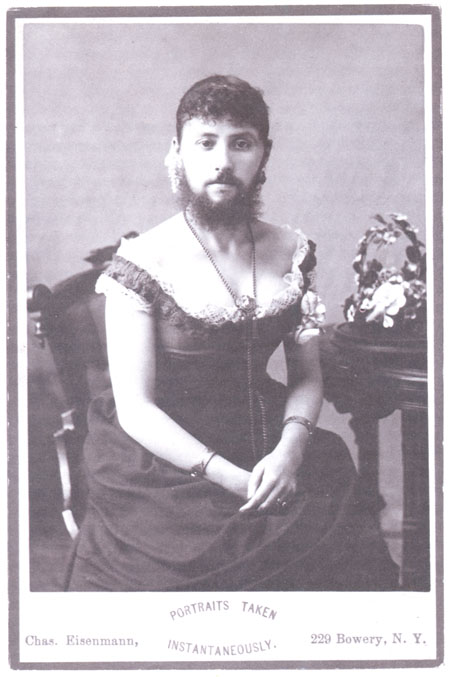
So What if I Have a Beard


The Bearded Lady

Why people find this particular topic interesting is that people are generally fascinated with monsters and freaks. It has probably happened to you once in your lifetime. When your walking down the street and you see something or someone so hideous or outrageously deformed, you cannot help but to keep looking. It is the same as when there is a car accident. On a physical level, the bearded lady is a truly bizarre phenomenon, but would it be that way if all women were capable of becoming like that? Say for instance that women, had they not shaved for about a month, could grow a beard as long and bushy as men on a regular basis, would we be so intrigued by it? No, we would be desensitized. Rather, we would be so used to it that most of us would consider it normal for women to have beards. In reality, most of our conceptions about what is weird or not is based on culture. Culture dictates everything. The more society agrees on the fact that women should look a certain way to be considered beautiful is a clear example of easily people can conform. If from now on, every major media entity promotes women with beards as the new standard of beauty, over a long enough time frame, it will become the new beauty.

Even with culture of today dictating what beauty is, these women are truly admirable. They risk ridicule and laughter every time they go outside. It takes courage beyond what most of us have to be able to live comfortably in their own bodies. It is commendable that there are still so many individuals out there who are willing to fight against the mass conformity and stand out as individuals. What is important is that most people today have lost a sense of being an individual means. We buy material goods of the same nature, having jobs that pay the same, in general doing things because that is what is considered right. These women teaches us a lesson that we should not soon forget: to be happy and proud of who you are and to do things that pleases you, not others.

Special Friendships

http://articles.latimes.com/1985-05-01/news/vw-11784_1_convent

Last week, I gave a presentation about nuns and the "special relationships" that was prevalent in convents. The article above is of a recent story where about 50 nuns from the Maryknoll Missionary Sister's Novitiate near St. Louis who decided to finally tell their story. They all contributed in writing the book called Lesbian Nuns: Breaking Silence the pressure of holding back secret truths that occurred in the convent was simply too much. The fact that so many sisters took part in co-authoring the book meant that this issue is far more widespread than people would think.

Personally, I did not know such erotic relationships would occur in a convent simply because I assumed nuns took their vows of chastity and devoted their lives completely to god. But whether these relationships were inevitable or spontaneous is the question that does not have a definite answer. In theory, it would seem inevitable since it was a setting where people of the same sex are forever secluded in one particular location. Relationships start off as sisters who are close friends become more intimate. The natural biological urges take over and though the sisters swore off sex, primal appeals can no longer be restrained. Another possibility lies in the theory that some sisters were lesbians to begin with. By joining a convent, they would not be judged by a harsh society and pursue their sexual interests in relative obscurity. Whether or not this particular type of sister exist is not known, but it is definitely a possibility.

Whether or not these theories hold true, it does make nuns seem less like saints and more like human beings capable of having feelings and emotions. Nuns have always held a place as glorified angels of heaven that were pure and free of mortal evils and sins. But knowing relationships do occur reassures the rest of us that they are indeed still humans too.

One of the most disheartening things about these special friendships is that people do in fact get hurt, physically or emotionally. As we have learned, some sisters who are more appealing attracted not only more girlfriends but also more scrutiny. Gossip, beatings, and small gestures of disapproval are all apart of the possible consequences of the convent. For those sisters who are not lesbians but received the negative side effects of what does occur, it is a shame. The workings of a convent are still relative quiet to the general public, but if there were to be reform, something to look at is the poor treatment of sisters by others.

Saturday, November 26, 2011

Gender Roles in Films


I recently read an article featured in the walls street journal in which an actress Greena Davis is advocating more female characters in kids G-rated films.  Greena Davis an academy award winner believes in gender equality in entertainment.  As an actor she always wanted to be challenged in a sport instead of being a girlfriend of someone that plays sports. In films women are given a few opportunities in which they can be depict in real life.   

She states that “And I was absolutely floored to see the same kind of gender bias and gender gap in what we're showing little kids. She'd be on my lap and I'd be counting the characters on my fingers and thinking, "This is just not right." She is advocating fixing the female characters there is for children. She believes that this greatly affects children moods and aspiration in life since studies shows the more television children watch the more constraint they obtain.
The female characters that do exist are highly stereotyped or highly sexualized.  The only aspiration in women characters for films is finding romance. The number one occupation for these characters is royalty.  The more a child sees television the more he or she depicts what is seen. Will this change why is it eminent that only males have and image to look up to. This equality is not alone in G-rated films it is also eminent in higher featured films.  A survey done in 2009 found that male’s roles still far outweigh those roles by women.  The top 100 grossing films of 2009 did the survey. The study found out that 32.8% of the 4,342 speaking characters where women, while 67.2% percent where men. I believe in the years to come the power medium of cinema will have a shift in gender starting roles. Filmmakers are starting to see the gender inequality dilemma.

Google Paying Gay Employees More

http://www.nytimes.com/2010/07/01/your-money/01benefits.html

Google to Add Pay to Cover a Tax for Same-Sex Benefits

Working for a company as rich as Google comes with an incredible number of fringe benefits: the free food, the free laundry, the doctor on duty at company headquarters and the impressive five months of maternity leave with full pay and benefits, to mention a few.

Peter Dasilva for The New York Times

Google is trying to eliminate the added tax burden for employees like Bennet Marks, left, and his husband, Kim Harris.

Bucks

Should companies cover the extra costs of domestic partner benefits?

Tara Siegel Bernard

is a personal finance reporter with The Times.

So it is not entirely surprising that the company is about to introduce another set of benefits that pushes the envelope — this time, geared toward its gay and lesbian workers.

On Thursday, Google is going to begin covering a cost that gay and lesbian employees must pay when their partners receive domestic partner health benefits, largely to compensate them for an extra tax that heterosexual married couples do not pay. The increase will be retroactive to the beginning of the year.

“It’s a fairly cutting edge thing to do,” said Todd A. Solomon, a partner in the employee benefits department of McDermott Will & Emery, a law firm in Chicago, and author of “Domestic Partner Benefits: An Employer’s Guide.”

Google is not the first company to make up for the extra tax. At least a few large employers already do. But benefits experts say Google’s move could inspire its Silicon Valley competitors to follow suit, because they compete for the same talent.

Under federal law, employer-provided health benefits for domestic partners are counted as taxable income, if the partner is not considered a dependent. The tax owed is based on the value of the partner’s coverage paid by the employer.

On average, employees with domestic partners will pay about $1,069 more a year in taxes than a married employee with the same coverage, according to a 2007 report by M. V. Lee Badgett, director of the Williams Institute, a research group that studies sexual orientation policy issues.

So Google is essentially going to cover those costs, putting same-sex couples on an even footing with heterosexual employees whose spouses and families receive health benefits.

The company began to look at the disparity after a gay employee pointed it out, said Laszlo Bock, Google’s vice president for people operations (also known as human resources). Google, by the way, says its benefits team seriously considers any suggestions on how to expand its coverage.

“We said, ‘You’re right, that doesn’t seem fair,’ so we looked into it,” Mr. Bock said. “From that initial suggestion, we said, let’s take a look at all the benefits we offer and see if we are being truly fair across the board.” As a result, the company also decided to make a few other changes that would help gay employees, including eliminating a one-year waiting period before qualifying for infertility benefits and including domestic partners in its family leave policy — going beyond the federal Family and Medical Leave Act, which requires employers to provide up to 12 weeks’ leave in a one-year period to recover from a medical condition or to care for a relative.

The extra compensation to cover the domestic partner tax will apply only to same-sex domestic partners, Mr. Bock said, because heterosexual couples can avoid the added tax by marrying. (Same-sex couples can make their unions official in several states, but their relationship will not be federally recognized.)

The additional pay will also cover the dependents of the employee’s domestic partner. The changes will be retroactive to Jan. 1, and will apply only to workers in the United States.

It is hard to say how many of Google’s 20,600 employees will be affected by the changes, but the company’s internal gay and lesbian group — they call themselves Gayglers — has about 700 members (though some members may simply support their gay and lesbian co-workers).

So what’s the cost of Google’s largess? Mr. Bock declined to provide details but said the decision was less about money and more about equalizing benefits. “If you were to add it all up, it’s not like we are talking hundreds of thousands per employee,” he said. “It will cost some money, but it was more about doing the right thing.”

The Kaiser Family Foundation says that 36 percent of large companies that offer health benefits provide coverage for same-sex domestic partners, and more than half of Fortune 500 companies provide domestic partner coverage — but few pay the extra costs of that coverage.

In California, even more companies may provide coverage because the state requires insurance products issued there to be extended to registered domestic partners.

Still, Google isn’t the first company to “gross up” their employees’ pay, as raises to cover taxes are known. According to the Human Rights Campaign, a handful of other organizations, including Cisco, Kimpton Hotels and the Gates Foundation, do so as well. Benefits experts said a few other companies provided the extra compensation, though it still amounted to a relatively small number.

But given the competitive nature of the benefits culture in Silicon Valley, where companies often offer extra perks to attract top employees, Google’s decision could lead to policy reviews, experts said.

“It could have a ripple effect, prompting other employers, and particularly employers in the same industry, to take a look at their own benefits package and see whether it would be appropriate to extend those benefits,” said Kathleen Murray, principal in the health and benefits consulting business in San Francisco for Mercer, the consulting firm. “When you have a high-profile company doing anything, that tends to get into the mind of the culture, and it can have a more diffuse effect.”

The company’s announcement came on the heels of a decision by the Labor Department to permit employees who are acting as parents to take leave under the Family and Medical Leave Act to care for a child, even if there are no legal or biological ties. But Google’s move would allow employees to care for a partner, too.

Congress has tried to address the fact that same-sex couples pay more for domestic partner health coverage. The health care overhaul legislation passed by the House last November included language that would have eliminated the tax on employer-provided coverage. But the provision did not make it into the final legislation signed byPresident Obama in March.

Google “has decided it’s in their best interest to treat employees with same-sex partners fairly,” said Daryl Herrschaft, who oversees theWorkplace Project of the Human Rights Campaign Foundation, “and that includes picking up the slack when federal law doesn’t recognize the diversity of today’s work force.”


In this article, "Google to Add Pay to Cover a Tax for Same-Sex Benefits", we see that Google is starting a new benefit for its gay employees. Along with the benefits of free food, free laundry, a doctor on duty at company headquarters, and five months of maternity leave with full pay, Google has added the benefit of "covering a cost that gay and lesbian employees must pay when their partners receive domestic partner health benefits, largely to compensate them for an extra tax that heterosexual married couples do not pay." Employees with domestic partners have to pay on average about $1069 more a year than a married employee with the same health coverage. This difference in cost is due to the government taxing the employer provided health benefits for gay and lesbian employees in a domestic partnership, and the tax can only be removed from their income if the employee's domestic partner is considered to be a dependent. This extra tax charge on gay and lesbian employee's income will be made up by Google in their new benefit.

Google making their homosexual employees the same as their heterosexual employees shows a step forward in society. Although other companies, such as Cisco, Kimpton Hotels, and the Gates Foundation, had previously done the same as Google in covering their employees tax by increasing their pay, Google's increase is greatly beneficial to our society because it is a widely popular and successful company. Seeing companies like Google taking action against the government's unfair consideration of homosexual couples in comparison to heterosexual couples provides incentive and encouragement towards other companies in doing the same. Additionally, this new benefit towards domestic partnership demonstrates society consideration of homesexual in comparison to heterosexual couples as this action has received a great positive response from society. So, it shows the borders between gender identities diminishing in today's eyes, with companies fighting back against the government's unjustly treatment of homosexual couples and the positive feedback Google received in fighting back.